Rh Negative Pregnancy Explained
- Home
- /
- Rh Negative Pregnancy Explained
Finding out you are pregnant brings a wave of excitement, but it can also come with a lot of medical terms that sound intimidating. If your doctor mentions the words "high-risk pregnancy" or tells you that you are "Rh-negative," your mind might immediately race with questions.
First, take a deep breath. A high-risk label does not mean something will go wrong; it simply means your healthcare team will monitor you more closely to keep both you and your baby perfectly safe.
In this guide, we will break down what makes a pregnancy high risk, look closely at Rh-negative pregnancies, and explain how modern medicine manages both with ease.
A high-risk pregnancy is any pregnancy where there is an increased chance of health complications for the mother, the baby, or both. Because of this, it requires extra care from a specialist, such as a perinatologist (a doctor who specializes in high-risk pregnancies).
There are many reasons a doctor might classify a pregnancy as high risk. They usually fall into four main categories:
Maternal Age: Being under 17 or over 35 when giving birth.
Existing Medical Conditions: Having high blood pressure, diabetes, kidney disease, autoimmune disorders, or thyroid issues before getting pregnant.
Pregnancy Complications: Conditions that develop during pregnancy, such as gestational diabetes or preeclampsia (severe high blood pressure).
Multiple Babies: Carrying twins, triplets, or more.
Another very common—yet highly manageable—reason a pregnancy receives extra attention is blood type incompatibility, specifically being Rh-negative.
To understand why being Rh-negative matters, we have to look at your blood type. Your blood type has a letter (A, B, AB, or O) and a factor: positive (+) or negative (-).
The plus or minus comes from the Rh factor, which is a specific protein found on the surface of your red blood cells.
If you have this protein, you are Rh-positive.
If you do not have this protein, you are Rh-negative.
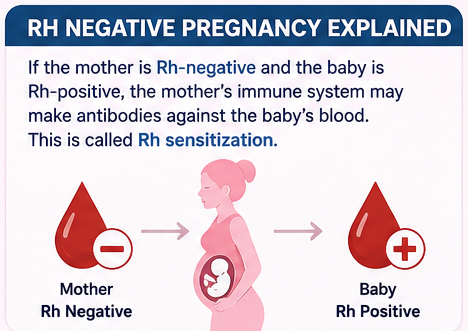
Being Rh-negative is completely healthy and normal. It only requires special medical attention when an Rh-negative mother is carrying an Rh-positive baby.
Why Can Rh Incompatibility Be a Risk?
Look at the visual timeline above. If an Rh-negative mother is pregnant with an Rh-positive baby (inherited from an Rh-positive father), their blood types do not match.
During pregnancy or delivery, a small amount of the baby’s blood can mix with the mother’s bloodstream. Because the mother’s body does not recognize the Rh protein, it treats it like a foreign invader (like a virus) and creates Rh antibodies to fight it off. This process is called Rh sensitization.
The Good News: This rarely affects a first pregnancy. The mother’s body usually doesn’t make enough antibodies fast enough to harm the first baby.
However, as the diagram shows, during a later pregnancy, if the next baby is also Rh-positive, those leftover antibodies can cross the placenta. They may begin to attack the baby's red blood cells, leading to a condition called Rh disease or hemolytic disease, which can cause severe anemia or jaundice in the newborn.
Fortunately, this is one of the most successfully managed conditions in modern medicine. If you are Rh-negative, your doctor will guide you through a routine, highly effective preventative treatment plan.
1.The Blood Test:First Prenatal Visit.
Your doctor will run a standard blood test early in your pregnancy to check your blood type and verify if you have already developed Rh antibodies.
2.The First Injection:Week 28 of Pregnancy.
If you haven't developed antibodies, you will receive an injection called RhoGAM (Rh immunoglobulin). This shot acts like a shield, preventing your immune system from reacting to the baby's Rh-positive blood cells.
3.The Final Injection:Within 72 Hours After Delivery.
After your baby is born, the doctors will test the baby's blood type. If your baby is Rh-positive, you will receive a second RhoGAM shot to protect your future pregnancies.
(Note: You may also receive a RhoGAM shot if you experience any vaginal bleeding, abdominal trauma, or miscarriages during your pregnancy, just to be safe.)
Being told your pregnancy is high risk or that you are Rh-negative can sound scary, but the reality is reassuring. With routine prenatal care, a simple blood test, and a couple of quick injections, Rh incompatibility is entirely preventable.
If your pregnancy is labeled high risk for Rh factor or any other reason, it simply means you will get more sneak peeks of your baby via ultrasound and extra attention from your medical team. Stay consistent with your doctor appointments, ask questions, and focus on enjoying your journey to motherhood!
If you have been told your pregnancy is high risk, or if you are Rh-negative and need dedicated care, finding the right healthcare partner makes all the difference.
At Shubham Care Hospital, we specialize in providing comprehensive, supportive, and advanced maternal care to ensure a safe journey for both you and your little one.
| Hospital / Doctor Details | Contact & Location |
| Hospital Name | Shubham Care Hospital |
| Lead Specialist | Dr. Shailesh Jain |
| Address | 201, Girraj Nagar, Iskcon Road, Mansarovar, Jaipur - 302029 |
| Contact Number | +91 9509438568 |


.png)

.png)